Overview
The system gives each driving scenario a complexity score between 0 and 10, showing how simple or complex the situation is. It works with different types of data, so it can analyse scenarios from various sources. The complexity score ultimately measures: "How challenging is this scenario for an autonomous driving system (ADS) to handle correctly without failing?". The complexity score is essentially a proxy for "how much does this scenario stress-test the ADS?"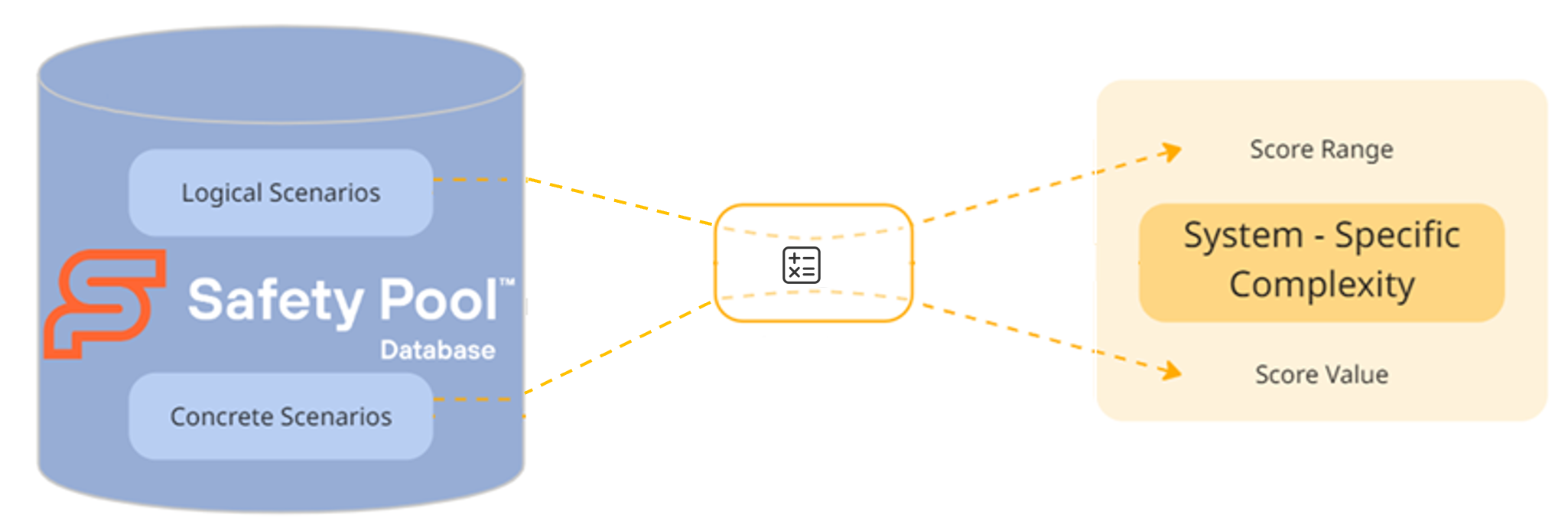
- For scenarios with fixed values (Concrete scenarios), it provides a single score.
- For scenarios with multiple possible variations(Logical scenarios), it provides a range of scores (minimum to maximum) to reflect different possibilities.
How the score is calculated
The total complexity score is the average of three sub-scores, each measuring a different dimension of difficulty. Every sub-score runs from 0 to 10.
Quantitative score (Quant)
Measures how much is happening in the scenario — the quantity and variety of elements present.
A scenario scores higher when it contains more actors (vehicles, pedestrians, cyclists), more types of road infrastructure, more hazardous surface or weather conditions, or unusual lane configurations. A busy urban intersection in heavy rain with multiple vehicle types will score much higher than a single car on a straight dry motorway.
Think of this as: "How crowded and varied is the environment?"
Deviation score (Dev)
Measures how unusual or hazardous the scenario is compared to everyday driving.
A scenario scores higher when it includes rare or dangerous elements — such as an accident cause (mechanical failure, animal intervention), an extreme hazard level (near-miss or fatal), adverse weather, poor visibility, or non-standard road surfaces. A scenario tagged with a fatal hazard and icy roads will score much higher than a routine sunny-day motorway drive.
Think of this as: "How far does this scenario deviate from normal, safe conditions?"
Variance score (Variance)
Measures how much the actors move and change throughout the scenario.
A scenario scores higher when vehicles travel at varying speeds, change position significantly, or perform many different manoeuvres across the scenario's timeline. A scenario where a vehicle accelerates, brakes sharply, and changes lanes repeatedly scores higher than one where everything moves at a constant speed in a straight line.
Think of this as: "How dynamic and unpredictable is the behaviour in this scenario?"
Score reference
| Total score | Complexity level | What it typically means |
|---|---|---|
| 0 – 2 | Low | Simple, routine conditions. Minimal stress on the ADS. |
| 3 – 5 | Moderate | Mix of standard and mildly challenging elements. |
| 6 – 8 | High | Difficult conditions — adverse weather, dense traffic, hazardous behaviour. |
| 9 – 10 | Very high | Extreme scenario. Multiple compounding hazards or rare, critical events. |